
For the past decade, enterprise technology marketing has presented public cloud migration as an inevitable, universal mandate. However, as organizations gain experience with recurring cloud invoices and network bandwidth constraints, the architectural conversation has matured.
Today's technology leaders understand that neither pure public cloud nor isolated on-premises infrastructure is an absolute solution. The real challenge is determining which specific workloads thrive in an elastic cloud environment and which remain more cost-effective, secure, and performant in an on-premises data center.
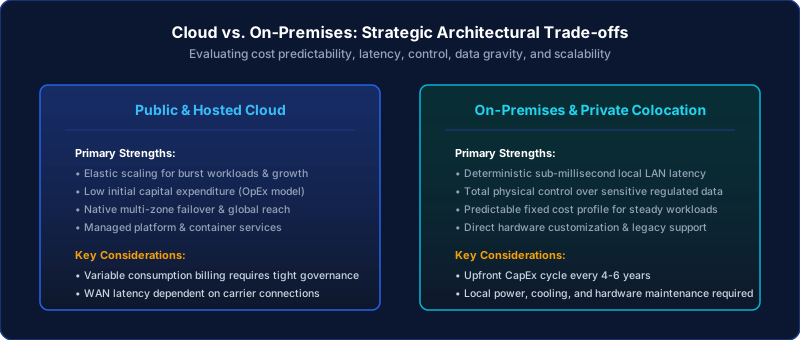
Figure 1: Core operational and architectural trade-offs between public cloud and on-premises environments.
1. Financial Dynamics: CapEx vs. OpEx Modeling
The financial distinction between on-premises and cloud models is frequently simplified as Capital Expenditure (CapEx) versus Operational Expenditure (OpEx). However, the real cost comparison involves far more than comparing a server purchase invoice against a monthly AWS or Azure subscription.
Consider the total cost of ownership (TCO) variables:
- On-Premises Predictability: Physical hardware (servers, SAN storage, switches) requires upfront capital investment amortized over 4 to 6 years. Aside from steady power and support contract renewals, monthly running costs are largely fixed and predictable.
- Cloud Variable Consumption: Cloud infrastructure replaces capital outlays with monthly consumption-based fees. While this eliminates upfront hardware costs, variable metrics such as network egress bandwidth, database IOPS, and API calls can lead to unpredictable month-to-month billing swings if not strictly governed.
2. Network Latency & Data Gravity
Data has mass and gravity. The larger a database or file repository grows, the more difficult, expensive, and slow it becomes to transfer across wide area network (WAN) connections.
Local Area Networks (LAN) deliver consistent sub-millisecond latency (under 1ms) between workstations and local server racks. In contrast, even high-speed fiber internet connections to cloud data centers typically introduce 15ms to 60ms of round-trip latency. For real-time applications such as Computer-Aided Design (CAD), massive database indexing, point-of-sale transactional processing, and local video editing, WAN latency can degrade the user experience significantly.
3. Workload Predictability & Sizing Characteristics
The nature of your application demand is the single most decisive factor when choosing an architecture:
- Elastic & Burst Workloads (Best for Cloud): Applications with sharp, unpredictable spikes in traffic—such as public web applications, seasonal marketing campaigns, or dev/test sandbox environments—benefit immensely from cloud auto-scaling. You pay only for the compute instances consumed during peak hours.
- Steady, High-IOPS Workloads (Best for On-Premises): Core transactional databases and enterprise applications that operate continuously with steady resource utilization are almost always significantly more cost-effective on dedicated on-premises hardware over a 5-year lifecycle.
| Evaluation Parameter | Public Cloud Infrastructure | On-Premises / Private Infrastructure |
|---|---|---|
| Cost Profile | OpEx: Flexible, consumption-based; requires tight governance to prevent cost creep. | CapEx: Upfront procurement; highly predictable ongoing operating expenses. |
| Deployment Speed | Immediate: Spin up instances, VPCs, and storage buckets in minutes. | Weeks to Months: Hardware procurement, rack installation, cabling, and hypervisor setup. |
| Internal Latency | Subject to WAN connection speed, ISP routing, and geographic distance (15–60ms). | Deterministic local switching fabric; sub-millisecond response (<1ms). |
| Disaster Recovery | Native multi-region redundancy, automated snapshot orchestration, and cloud vaults. | Requires secondary colocation facility, redundant hardware, and replication links. |
| Regulatory Control | Shared responsibility model; relies on provider compliance certifications. | Direct physical possession of storage drives and local network auditability. |
4. The Modern Standard: Hybrid Architecture
For the vast majority of organizations, the debate between cloud and on-premises is not binary. The modern enterprise consensus is a deliberate hybrid infrastructure model:
A well-designed hybrid architecture places customer-facing services, email collaboration (Microsoft 365 / Google Workspace), and immutable backup copies into the public cloud, while maintaining mission-critical core databases, sensitive customer archives, and high-throughput local applications on a hardened, virtualized on-premises cluster.
How to Approach Your Decision
Before committing to an expensive cloud migration or an extensive hardware refresh, perform a comprehensive workload placement assessment. Catalog every core software package, measure actual IOPS and network traffic, and evaluate the 5-year financial impact of both paths.
Gridwell Tech provides independent, vendor-neutral Cloud Infrastructure Consulting and Server & Systems Consulting to help you determine the optimal architectural balance for your organization.